


Corey Alston's Sweetgrass Baskets Were Made to Be Used

Corey Alston is a Gullah Geechee sweetgrass basket maker from Mount Pleasant, South Carolina. His work is in the permanent collection of the Smithsonian American Art Museum, and in July Guinness World Records confirmed that he had made the largest sweetgrass basket in the world. Most days he still weaves at his stall in the Charleston City Market, which is where we met him in August. This fall a small group of his sweetgrass baskets comes to Southern Crafted.
The museums aren't the most interesting thing about him, though. His view of what a basket is for is.
The museums aren't the most interesting thing about him, though. His view of what a basket is for is.
Why Old Sweetgrass Baskets Go Brittle on the Shelf
Sweetgrass baskets that sit unused on a shelf for decades dry out, and that is the damage Corey is most often asked to repair. Someone brings him a family piece, older than the person carrying it, and the trouble is usually the same. The grass has gone brittle and the coils have started to let go.
Age isn't so much what causes sweetgrass baskets to deteriorate. The shelf is.
These baskets were never made just to be looked at. In the Lowcountry they were made for work, in the house and on the farm. The oldest form, the wide, shallow fanner, was used to winnow rice. The grain went up into the wind, the chaff blew off, and the rice fell back into the bulrush. A sweetgrass basket that gets filled, emptied and handled keeps some of the life it was made for. One that sits untouched for thirty years dries out.
Corey is firm about this. The baskets were made to be used, and they still should be.

From the Charleston City Market to the Smithsonian
Corey Alston's baskets are held by the Smithsonian American Art Museum, the Mint Museum in Charlotte and the South Carolina State Museum. From the aisle of the City Market you could easily take him for one weaver among many. He isn't.
The Smithsonian acquired From Traditional to Contemporary, a coiled sweetgrass basket 33 inches across, in 2021; it hangs in the Renwick Gallery. He was named a United States Artists Fellow in 2024. In 2025 the Mint Museum bought Da Lowcountry Coasta, his first oval sculpture, a looping form of bulrush, sweetgrass and palmetto. The idea came from the rollercoasters at Carowinds, which he'd passed for years on I-77. "Once I looped it," he told the Mint, "the whole dynamic changed."
Then came Big Percy. The South Carolina State Museum commissioned it in the fall of 2024, Corey began weaving in February 2025, and the museum unveiled it on February 19, 2026. It stands 52.6 inches tall, measures 135 inches around and weighs 80 pounds. About 85 percent of it is bulrush, not sweetgrass. Bulrush is the older material and the tougher one, and it's what lets a basket that size hold its shape. Harvesting it, he has said, "tears up our hands, but we have to do it."
The Mint calls him the leading sweetgrass basket maker of his generation. He is more modest about it. Of Big Percy he said, "When museums give you the funding and the time, then I think anyone could have done it." Nobody else has.
How Corey Alston Learned to Make Sweetgrass Baskets
Corey Alston learned sweetgrass basketry by marrying into it: he was taught by his wife and his mother-in-law, and he credits the women of that family for everything that followed. He didn't grow up weaving. He was raised in Mount Pleasant in a family of blacksmiths.
Karen Habersham, whose family has kept the coiled tradition for generations. Her ancestors grew rice, and the baskets came from that work. The family matriarch was Karen's grandmother, Mary Jane Manigault, a nationally recognized weaver. Corey didn't start until she gave her blessing. "You don't just decide to make baskets," he has said. "You're allowed to."
The craft has always moved this way in Mount Pleasant: by hand, inside a family, at a pace that won't be hurried. The technique descends from the coiled rice baskets of Sierra Leone. A basket starts as a tight spiral anchored with palmetto, and every row after it inherits that center; if the center is off, so is the whole basket. The work is sewn rather than woven, using a tool weavers call a sewing bone, traditionally a filed-down spoon handle or a flattened nail. Getting the coils tight and even is where the difficulty lives.
He is passing it on in turn, teaching the next generation of the family. And he is clear about what the tradition carries: "From an art form of forced slave labor to now being recognized as one of the oldest handcrafted arts in the world, to be a world record holder is everything to me and the generations to come."

How to Use a Sweetgrass Basket at Home
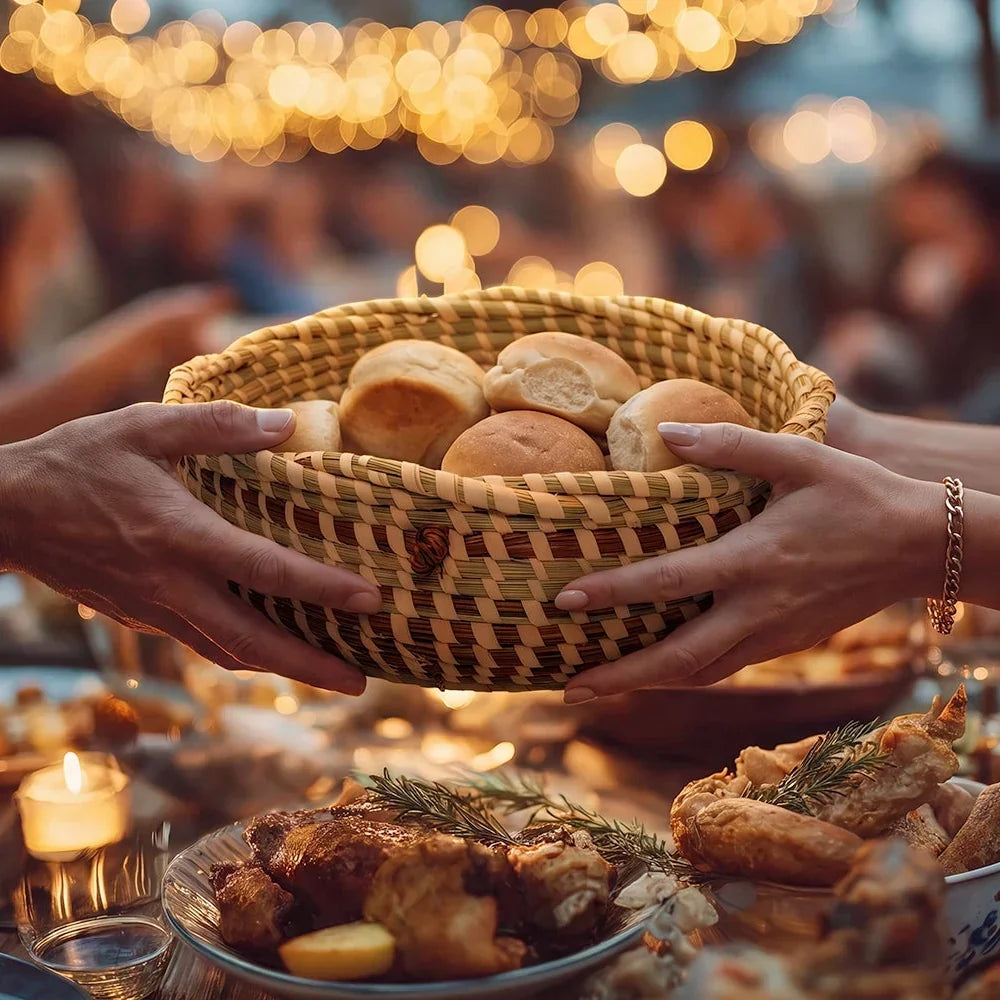
A sweetgrass basket belongs where hands will find it: on the sideboard with bread in it during dinner, by the door holding the mail and the dog's lead, or on the kitchen island with lemons all winter. That is the whole of Corey's argument, and it's the easiest one in the world to take up.
New sweetgrass smells faintly of fresh hay. The color comes from the materials themselves, with no dye: pale sweetgrass, darker bulrush, the lighter strips of palmetto. Over years of use they settle into something warmer. That aging is the basket working as intended.
We have a small group of Corey's sweetgrass baskets, a few medium pieces sized for the table and a few of his larger banner baskets, opening on The Short List on October 15. We bought them directly from Corey at the City Market, and each one is photographed and listed as the piece it is.
If you're in Savannah before April 4, the Telfair Museums's Roots in the Rushes at the Telfair Academy is three blocks from our door and tells the long history of Lowcountry sweetgrass baskets better than any shop could.
And if one of his baskets comes home with you, use it. He'd rather you did.
Questions About Corey Alston and Sweetgrass Baskets
Who is Corey Alston?
Corey Alston is a Gullah Geechee sweetgrass basket maker from Mount Pleasant, South Carolina, who weaves at the Charleston City Market. His work is in the Smithsonian American Art Museum and the Mint Museum, and his basket Big Percy was confirmed by Guinness World Records in July 2026 as the largest sweetgrass basket in the world. A small group of his sweetgrass baskets opens on Southern Crafted's The Short List on October 15, 2026.
What is the difference between sweetgrass and bulrush?
Both are grasses used in Lowcountry coiled basketry. Sweetgrass is fine, pale and fragrant, often compared to fresh hay. Bulrush is darker, harder and stronger, and it is the older material: the first fanner baskets, used to winnow rice, were made from it. Makers use bulrush for strength in large pieces; Corey Alston's Big Percy is about 85 percent bulrush.
Why do old sweetgrass baskets become brittle?
Sweetgrass baskets that sit unused on a shelf for years dry out, and the coils can start to loosen. They were made as working baskets for the house and the fields, and Corey Alston holds that they should still be used, which is how they keep their life.
Where can I see or buy an authentic Gullah sweetgrass basket?
In Charleston, sweetgrass basket makers weave and sell at the Charleston City Market, and in Mount Pleasant at the Sweetgrass Cultural Arts Pavilion; buying from someone you can watch weave is the surest sign of authenticity. In Savannah, Telfair Museums' Roots in the Rushes exhibition runs through April 4, 2027. Southern Crafted offers a small group of Corey Alston's sweetgrass baskets on The Short List beginning October 15, 2026.

Ashley McCorkle is a founder of Southern Crafted. He comes from a product design background and writes about consumer trends and design.