


Article: Pressed Flowers Under Glass
Pressed Flowers Under Glass

Pressed flowers are everywhere again — on fabric, in galleries, in frames above consoles. The practice is five hundred years old and started as a way for botanists to preserve plant specimens, rather than a decorative art. What it has always been good at is preserving that one particular blossom, from one particular day.
What it is
A pressed botanical is a plant dried flat under weight and mounted, usually on paper, usually behind glass. Not a drawing of a flower. Not a photograph of one. The flower itself — the one that grew, cut once, held in whatever shape the press gave it.
That distinction sounds like a technicality. Most of what follows is about why it isn't.
For most of the nineteenth century this was women's work, and it was one of the few kinds of serious work on offer. Botany was the single science a middle-class woman was encouraged to take up: it suited Romantic ideas about nature. A literature grew up to serve her — John Lindley's Ladies' Botany, Maund's The Botanic Garden, Edwards's Botanical Register.
Alongside it ran the language of flowers: books assigning a meaning to every plant, near-ubiquitous from about 1820 to 1870, kept in parlors and carried on picnics. A flower laid down on a page was already saying something before anyone thought to frame it.
Two centuries on, the work is still mostly women's. Artist Tricia Paoluccio's pressed flowers wound up on Anna Wintour's gown at the Met Gala and Taylor Swift's at the Grammys. Sandy Whitaker has been pressing and framing flowers at her kitchen counter in Cartersville, Georgia, for more than twenty years. The practice reached them both more or less intact.

Why they came back
The clearest marker is Oscar de la Renta's Fall/Winter 2021 collection, whose floral fabric was printed from photographs of real pressed flowers by the artist Tricia Paoluccio. She had spent five months of 2020 on her parents' farm in Modesto, California, picking and pressing wildflowers for a collection nobody had yet agreed to make. “I decided I'm going to pick these flowers as if Oscar de la Renta will happen,” she said. She found out that Taylor Swift was wearing one of them in the middle of the Grammys broadcast. Paoluccio had also spent the pandemic teaching strangers how to press a flower without turning it brown, and had gathered some eight thousand people doing it.
Her work has since moved into galleries in New York and San Francisco, and onto porcelain, wallpaper, knitwear and rugs. She is not alone in that migration. Marian McEvoy spent a career in magazines — European editor of Women's Wear Daily and W in Paris, founding editor of Elle Decor, editor-in-chief of House Beautiful — then retired to an eighteenth-century farmhouse above the Hudson and began making botanical collages from roughly two hundred baskets of dried flowers, leaves, acorns and pinecones. She lays the botanicals in the sun first so they fade evenly. “Whatever motif I come up with comes from the shape of the leaves or flowers,” she says, “and sometimes the color.”

But the thing that has actually put pressed flowers in front of most people is weddings. Andrea Castaneda learned to press from her boyfriend's grandmother, framed her first bouquet on Valentine's Day in 2016, left her marketing job three years later, and now makes ninety-five percent of her living pressing wedding florals in Dallas. The argument is hard to refute: a couple spends thousands on flowers that are in a bin by Tuesday. She has four days after the wedding to collect them, two months in the press, and four to six to deliver the finished frame.
A small industry has grown up doing this, and for most people it is where the whole idea is first encountered — not in a gallery, but at the point where something they paid for and cared about was about to be thrown away.
The timing isn't accidental. Pattern came back after the pandemic and has not left. In 1stDibs' survey of designers for 2026, 39 percent expect layered, maximalist rooms to keep going and 22 percent expect florals and botanicals specifically to keep trending; wallpaper is going up on ceilings. Minimalism hasn't died — it is holding steady — but it stopped being the only available answer, and the rooms that came back alongside it have walls that want filling.

Southern decorating was waiting for this. James Farmer, working out of Perry, Georgia, brings the garden indoors as a matter of course — hydrangea wallpaper climbing an entry, camellias in the study fabric, framed pressed flowers on the walls of the rooms in his books. His stated aim gives the game away. “I strive to make every house I decorate feel like it was inherited versus purchased.” A framed pressed flower is close to the most inherited-looking object a room can hold, and unlike the wallpaper it is the actual plant.
The usual explanation is that people want things made by hand, which is true and not quite sufficient. A pressed flower is also the opposite of a screen. One plant, one season, holding still.
Where it comes from
The practice begins with a physician. Luca Ghini, who had been lecturing on medicinal plants at Bologna since 1527, moved to Pisa in 1544, founded the garden that became the Orto botanico, and made the first recorded herbarium — plants dried between sheets of paper and glued onto card. None of his own survive. One his student Gherardo Cibo made around 1532 does.
What an herbarium was for was settling arguments. A pressed flower on a sheet does what a written description cannot: this is the plant, this is what it looked like, this is where it was found and when.
The practice left the universities quickly. By the nineteenth century the album was a domestic object: pages of pressed specimens, named in the collector's own hand, assembled at home and shown to visitors.

A sidebar: Emily Dickinson's album
The most famous surviving example belonged to a girl in Amherst. Future poet Emily Dickinson finished her book of pressed flowers by about the age of fourteen — 424 specimens across 66 leaves, fixed down with narrow paper strips, the plants picked and pressed in the early 1840s.
She labeled every specimen with its scientific name in her own hand. Native plants, naturalized plants and houseplants sit together with no evident organizing principle. Narcissus, viola and buttercup each take a whole page to their varieties.
The first specimen in the book is jasmine, which in the language of flowers can stand for poetry. Harvard's curator Leslie Morris, who has spent more time with the album than most, declines to make much of it: “I think that you could read a lot into the herbarium if you wanted to.”
It lives at Harvard's Houghton Library now, too fragile to handle and kept for years in a vault. A full-color facsimile was published online in 2006.
Why people collect them
A pressed sheet is not a catalog entry. Asa Gray, who left his collection to Harvard in 1865, called the herbarium “the only certain record of species,” and the claim has aged better than he could have known. In 2016 researchers recovered genetic material from a single 1875 specimen of Hesperelaea, collected on Guadalupe Island and extinct ever since. At the Carnegie Museum two eastern redbuds sit together, gathered at the same Pennsylvania site on the same date 102 years apart — the 1915 sheet in full flower, the 2017 sheet already leafed out and fruiting; across 47 specimens the museum reads spring arriving about 1.3 days earlier each decade. And in 2015 researchers including Harvard Forest's Aaron Ellison reconstructed flowering dates for twenty Massachusetts species off sheets going back to 1852, and found they faithfully matched what observers had written down in the field those same years.
A flower pressed in 1852 for no scientific purpose whatsoever turns out to be an instrument reading.
Which brings a collector to a distinction worth being exact about. A pressing is one of one. The plant was cut once, in one season, and laid down once. A reproduction of that pressing — a scan, printed on paper, framed — can be made as many times as anyone likes. Both can be lovely. Only one of them is the plant.

And then Sandy Whitaker
All of which is a long way around to a woman in Cartersville, Georgia, pressing flowers at her kitchen counter.
Sandy Whitaker raised four children and went looking for something of her own once they had gone. On a trip to Chattanooga for her husband's fiftieth birthday she found pressed botanicals in a shop at eight hundred dollars apiece, wanted ten of them, and decided to make her own instead. She has been at it for more than twenty years, full-time since 2011.
Most of what she presses she grows — hydrangea, fern, dogwood, out of her own backyard, cut in the morning and into the press the same day. The rest she gathers from roadsides and woods. Hydrangeas are the difficult ones: dense heads, bruising petals, and most attempts come out brown. She worked at them until they didn't, and they have been her best-known subject ever since. The blue are the ones she grew up with, at her grandmother's house.
Nothing is laid out to a pattern. “I try to picture them as they are in nature,” she says, “and let the flowers speak for themselves.”
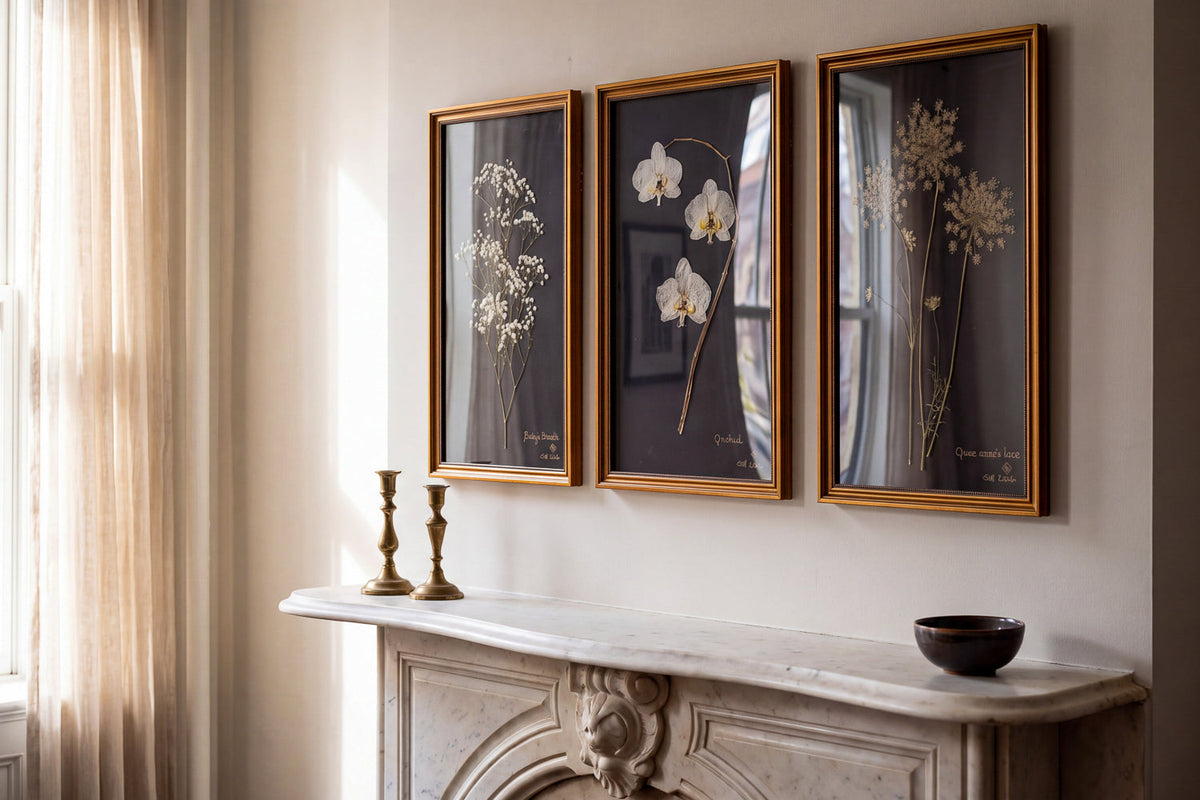
When a piece is finished she letters the botanical name into the corner by hand, with her monogram and the year.
That is the same convention Dickinson used in Amherst in the 1840s, and the one Ghini needed in Pisa in 1544, for the same reason. A plant without its name and its date is a decoration. With them, it is a record.
We have a limited release of nine delicate white flowers...hydrangeas, dogwoods, orchids...mounted on black, which she almost never does.